- You have no items in your shopping cart
- Subtotal: $0.00
Borosilicate Glassware Manufacturer – Precision and Performance
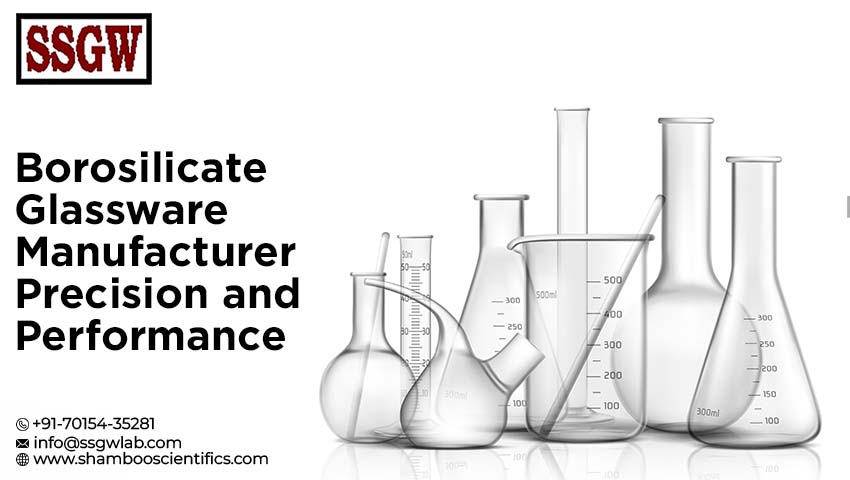
Borosilicate glassware manufacturer has become a critical component of any laboratory setup, driven by the need for durability, accuracy and thermal stability in the scientific research and the laboratory innovation sector. They are recognized for producing the glass that can withstand aggressive high temperatures or chemical reactions while advancing the scientific discovery.
This blog will examine borosilicate glassware producers and their significance in contemporary laboratories, the manufacturing process that results in its superior quality compound, its advantages over traditional glass and how it impacts the way reliability is defined in the laboratory research environment.
Examination of the borosilicate glassware
Borosilicate glassware is distinctive because it has the different chemical composition, a mixture of silica and boron trioxide. This results in a glass that has increased thermal and chemical stability, making it suitable for use in laboratories, industrial applications and cooking.
Borosilicate glass has the following characteristics:
- Thermal Shock Resistance: It can withstand rapid changes in the temperature.
- Chemical Resistance: It can withstand acids, alkalis and the organic solvents.
- Vision Clarity: It allows for visual inspection while performing the experimental work.
- Longevity: It has long lifespan and will be replaced less.
These characteristics explain why it is universal in the hands of scientists, researchers, and industrial engineers.
How Borosilicate Glassware Manufacturer Achieve Perfection
There is a process of vastly skilled craftsmanship and technology that goes into the final product of any quality lab glassware. Highly skilled borosilicate glassware manufacturers execute precise steps in the process that will guarantee the best quality and consistency:
- Production Material: Pure silica sand, boron oxide and alumina are selected to create the proper composition.
- Melting Process: The materials are melted in the high temperature furnaces at the temperature greater than 1,600°C to create a uniform glass.
- Forming: Automated machines instantly form glass beakers, flasks and tubes from the molten glass into various shapes and sizes.
- Annealing: The glass is then cooled slowly in order to relieve internal stresses but still retains the general strength.
- Testing: All pieces are tested for the chemical resistance and heat, before being sent out.
The combination of tradition and the technology permits manufacturers to achieve a balance of exacting engineering and imaginative production.
Comparing The Laboratory Glass
| Feature | Borosilicate Glassware | Soda-Lime Glassware | Plastic Labware |
| Thermal Resistance | Excellent (up to 400°C) | Poor (up to 100°C) | Very Low |
| Chemical Resistance | High | Moderate | Low |
| Durability | Long-lasting and sturdy | Brittle | Prone to deformation |
| Transparency | Crystal clear | Clear but less refined | Cloudy over time |
| Eco-friendliness | Recyclable and sustainable | Recyclable | Non-recyclable |
The table reflects why borosilicate glass continues to be the primary glass of the dependability and sustainability for the laboratories.
Benefits of Using the Borosilicate Glassware
When considering the different materials in the comparison, the borosilicate glassware, as the data suggests, surpasses the scientific accuracy and the functionality.
The following are a highlight of the benefits:
- Very High Heat Resistance: making it ideal for the heating and cooling experiments.
- Chemical Stability: absolutely no leaching or reaction with anything contained in the glassware.
- Cost: Although borosilicate glass is somewhat costlier than most materials today, in the long run, considering the life expectancy and its thermal-resistant stability, borosilicate glass is a worthwhile investment.
- Aesthetic and Functional Value: It is in fact completely transparent and allows for a good view of the chemical reactions that are occurring.
All these reasons explain why borosilicate glassware manufacturer remain the leaders in laboratory and industrial innovation.
Borosilicate glassware is useful outside the lab as well. Its versatility has allowed it to excel in the other industries such as:
- Pharmaceuticals: for the drug development and sterile storage
- Chemical Research: for safe handling of the harsh reagents
- Food and Beverage: employed for heat resistant cookware and the containers
- Optical and Electronics: required for precision parts in the high-tech device manufacturing
The growing use of borosilicate glass in different industries is evidence of its high quality and exceptional durability.
Conclusion
Due to evolving industries, the borosilicate glassware manufacturer are becoming increasingly vital. Their emphasis on strong construction, purity and accuracy allows labs and the industries to work effectively and safely. Shamboo Scientifics is one of these relevant contributors, which aims to provide only the finest quality laboratory glassware and scientific apparatus. With a diversified product line with international standards in mind, excellence of every experiment, every discovery, and every innovation is guaranteed.
FAQs
Q. What is the speciality of the borosilicate glassware?
A. It is special because of its high resistance to thermal shock and its resistance to chemicals.
Q. How do manufacturers test the borosilicate glassware for the quality
A. Manufacturers test borosilicate glassware for the quality through careful melting, shaping, annealing and testing processes.
Q. How this borosilicate glassware environmentally friendly
A. Borosilicate glassware is recyclable, sustainable, long lasting and therefore environmentally friendly.
Q. How this borosilicate glassware is better than plastic labware?
A. Borosilicate is much more durable than plastic – heat resistant, stronger, isotropic material and environmentally friendly.